

I once wrote a column for another publication called “The End Of Big Thump.” You can’t find it on the Internet anymore because that website is undergoing reconstructive surgery and I fear it shall never be restored. But the point of the column was this: I posited that, thanks to emissions laws, big 650cc dual sports were basically done for.
That was nine years ago and I was partly wrong. The Suzuki DR650 is still in production. The Honda XR650L is still in production. The Kawasaki KLR650 actually saw an update in 2022, adding EFI and optional ABS. And the Suzuki DR-Z400S, which isn’t really a 650 but is close enough that it’s worth considering, also saw an update in 2025, adding EFI and ABS as well. The KTM 690 Enduro R appears to be prepping for an overhaul in 2026, which means the Husqvarna 701 Enduro will also likely see some changes soon, and maybe the GasGas ES700 Enduro as well. There are a lot of big thumpers still in production.
My diatribe was also partly right, though. The second paragraph of that article read:
For almost three decades now, the 650 class has been the pinnacle of the on/off-road segment, for good reason. Bikes like Kawasaki’s KLR650, Suzuki’s DR650, Honda’s XR650L, and other similar models have long offered a unique blend of capability and affordability. But that might not be available for much longer.
This part, sadly, turned out to be true. There are new, big single-cylinder dual sports coming out, but take a close look at the two most recent examples. The new Kawasaki KLR650 is not as capable as its predecessors. The Suzuki DR-Z4S is not as affordable as its predecessors. The new 690 from KTM will be expensive, and Ducati’s new thumper is certainly not budget-friendly.
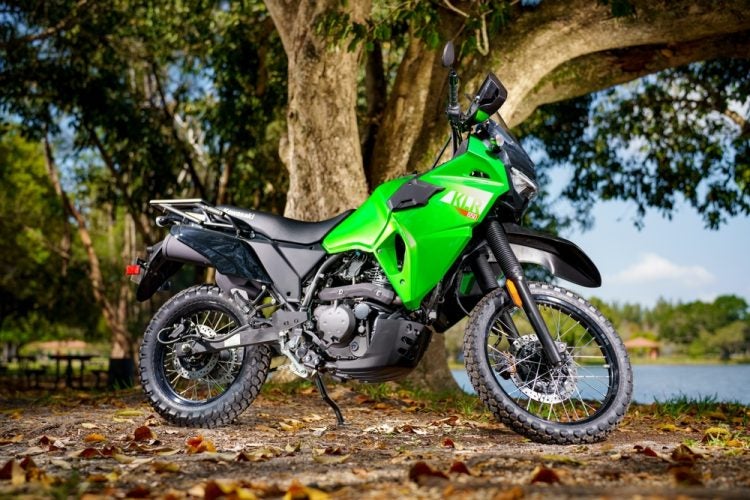
The new Kawasaki KLR650 comes at an excellent price point, but it is much less of an off-roader than the original Gen 1 model. The upgrades brought some weight gain with them. That’s just part of the trade-off you can expect on a new machine. Photo: Felix Mizioznikov / Shutterstock.com
The 650 dual sport was always the ultimate compromise, offering enough power to haul you at highway speeds all day long while still light enough that it could handle dirt riding. You gave up the power and comfort of a multi-cylinder ADV for the off-road usefulness. You gave up some dirt capability in exchange for streetability. On top of it all, because these bikes were simple and the designs didn’t really change much, you saved money to boot.
I applaud Kawasaki’s re-introduction of the KLR; I think it’s a great motorcycle, but the weight gain on the latest model is unfortunate. As for Suzuki, nobody ever thought they’d overhaul their DR-Z400S, but they did; it’s just too bad that the price tag had to rise so much.
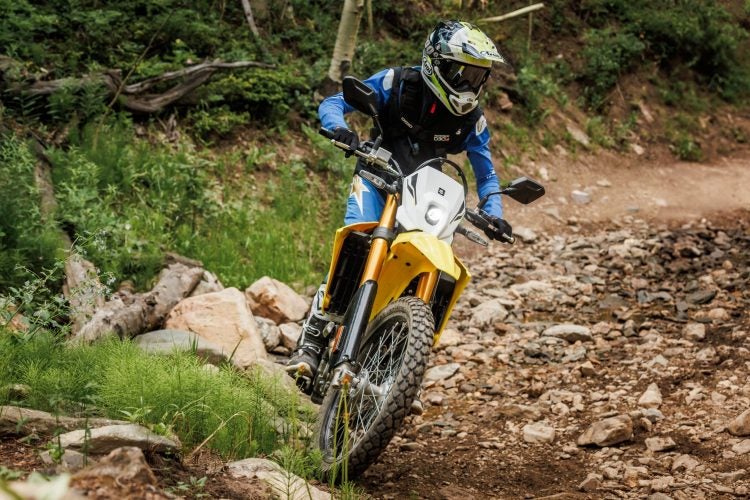
With the new Suzuki DR-Z4S, off-road capability was kept as a priority, but that meant the price went up, especially since it’s still manufactured in their Hamamatsu factory. Other Japanese OEMs lower their prices by off-loading production to Thailand. This is the case with the KLR and CRF300 models. Photo: Suzuki
But in both of these cases, this is the cost of doing business. It’s like the old three-way riddle: “Low-priced, Reliable, Lightweight: You can only pick two, so choose carefully.” Kawi went with the first two options, and presumably, Suzuki went with the last two options (we haven’t had our greedy little mitts on the bike ourselves, so we can’t say for sure that it’s reliable, but presumably Suzuki continued their tradition of mechanical excellence).
Judging by the comments I see in forums and on Facebook, there are two schools of thought here. The first is: “So what? I can buy a Tenere 700 now, and that’s way better.” Fair enough; if you have the money, a T7 is indeed a nice bike.
The second school of thought is comprised of people who valued the affordability and broad performance capabilities of the previous 650 models. They wonder why the newer thumpers come with the downsides mentioned above, and why even older dinosaurs like the DR650 have seen MSRPs rise over the past few years.
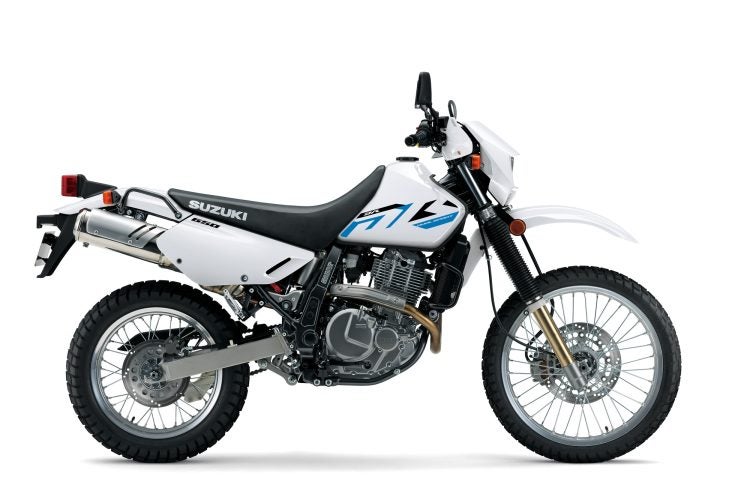
Even the DR650, which hasn’t seen a serious upgrade *ever* in its history, has seen an MSRP hike in recent years. And it’s not due to greedy dealers or OEMs; it’s because your dollar’s buying power has declined, while OEM costs have risen. Photo: Suzuki
As James Carville would have told you all the way back in 1992, “It’s the economy, stupid.” The reality is that the older thumpers were originally built because of the buying power of the middle class before the 2008 financial meltdown—the results of which have never really been sorted out. Our dollar is worth less now, manufacturers’ costs are rising, the middle class buying power is weakening, and regulators’ manipulation of the economy via EV and emissions mandates also make new bike development harder to justify. This is especially true for smaller markets like North America. What makes more sense for Honda: Develop a new 650 thumper for a few thousand buyers in the US, or refine their CRF300L platform for a few million buyers worldwide?
There’s a reason why Honda nailed down nearly one-third of all global motorcycle sales in 2024: They are smart enough to make the second choice. And it’s why, in a decade’s time, the 300 class is going to replace 650 thumpers as the dual sport of choice—unless EV mandates make the whole question irrelevant anyway.
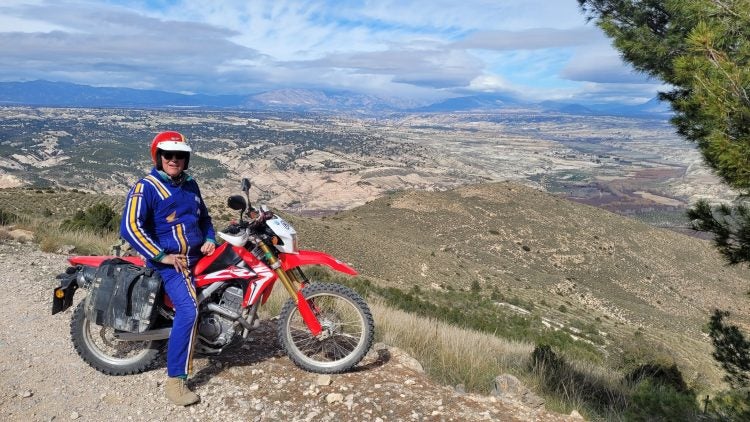
Six-fifty thumpers might not be dead in North America, but they are already unavailable in much of the global market. Euro-based adventurers like Austin Vince have been using Honda’s CRF-L series machines instead. Over the past decade, riders from the UK and EU have used these bikes instead of the old big-bore models that once defined budget-minded Euro adventure touring. Photo: Austin Vince
By the end of 2025, Honda says it will introduce 10 electric motorcycles. By 2030, it’s supposed to have 30 electric motorcycles in their global lineup. And by 2035, a lot of government leaders say they’ll have internal combustion bans in place. I think that, given the current fourth-turning scenarios we see playing out across the globe, it’s impossible to predict how much of this will come true. But if things play out the way they’re being currently planned, it won’t be your 650 thumper that you’re lamenting in a decade’s time; it might be internal combustion itself. If Big Money oversaw the demise of the middle class and the motorcycles it loved, we might see that as a prediction as to how the future of all gasoline-powered motorcycles will play out over the next few years.
Does that mean a world where motorcycles only serve as hyperbike playtoys for the elite or utilitarian delivery vehicles for underpaid urban dwellers? I hope not. But we’ll see.
Trail Break runs on the first Monday of every month, unless Zac forgets about it, or gets worked up about something in the days in-between scheduled columns … which was the case here.