
Harley-Davidson released its Q1 2025 financial results, and for Harley-Davidson Motor Company, pretty much all but one financial stat is miserable. Starting with the good news, sort of, the MoCo beat analysts’ earnings per share expectations at $1.07 per share. However, the “beat” earnings numbers are actually down about 38 percent per share from a year ago. That’s about it for the good news.
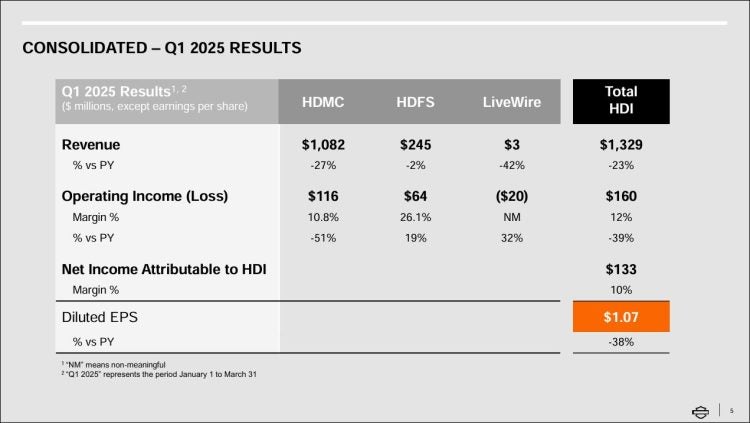
Image: Harley-Davidson
The not-so-good news, actually poor news, is that pretty much everything else declined by substantial amounts. Global retail motorcycle sales were down 21 percent year over year. The MoCo once again blamed “…a volatile macro environment…” along with overall consumer uncertainty. Revenue was also down again, this time 27 percent year over year,” with the MoCo saying the decline was “…primarily due to a planned decrease in motorcycle shipments.” Operating income was also down to $116M, which is down 51 percent from the prior year.
Global Sales Hit
With the above news, you might be wondering how the MoCo fared in the rest of the world. The unfortunate news is that while North America’s retail sales decline of 24 percent is a very large number, it’s not the biggest decline. Retail sales of Harley-Davidsons in Asia tanked 28 percent compared to last year. Latin America saw a 6 percent drop, while EMEA (Europe, Middle East, and Africa) performed the “best” with only a 2 percent decrease. With the reduction in its international sales, Harley’s European market share fell 3 percent year over year. Looking ahead, potentially detracting from future MoCo international sales is the current tariff war, which could make it even more difficult to sell outside of the USA.
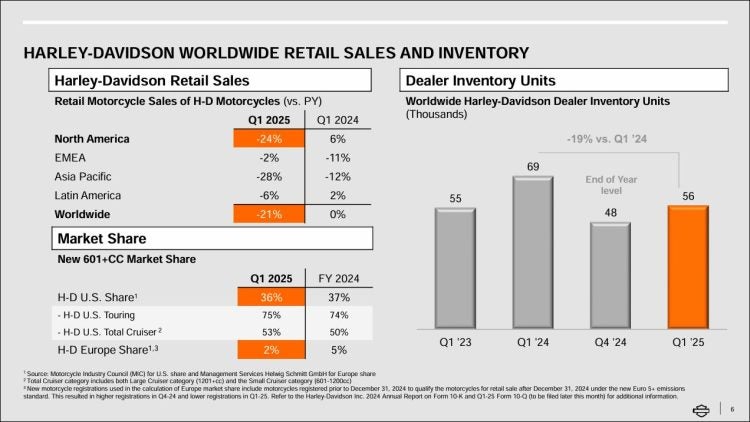
Image: Harley-Davidson
Decreasing Operating Income Margin (Profit)
Investors use operating income margin as a way to measure how efficiently a company is being managed. In Harley’s first quarter, its operating margin shrank significantly year over year. In Q1 2024, the MoCo posted an operating margin of 16.2 percent. For Q1 2025, that margin shrank by approximately one-third, coming in at 10.8 percent.
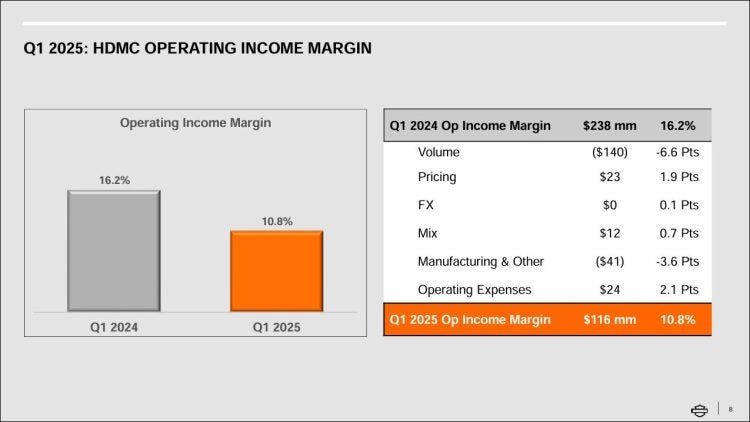
Image: Harley-Davidson
The LiveWire Fiasco
Things were even worse for Harley’s LiveWire electric motorcycle company. In all of Q1 2025, LiveWire managed to sell only 33 motorcycles, down 72 percent from the prior year. Even its kids’ STACYC balance bike business suffered, with sales down by 33 percent. In total for the LiveWire brand, revenue decreased 42 percent to only $3M.
To try to offset their sinking revenues, LiveWire has been cutting its costs deeply. The company closed its California office and moved back to its parent company’s facilities. They claim to have reduced “…selling, administrative, and engineering expense…” by $7M and streamlined headcount (i.e., laid people off). With the reduction in engineering costs, one has to wonder what effect it will have on LiveWire’s performance, reliability, and future potential.
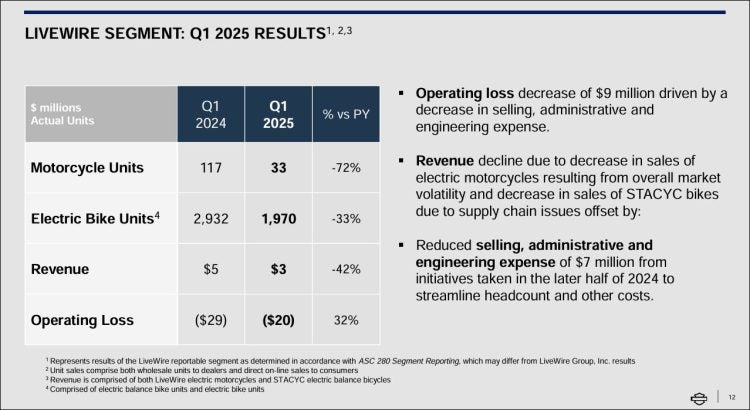
Image: Harley-Davidson
The Spears Fly
Harley’s latest financial results could hurt the MoCo’s reputation with its shareholders even more. For about two years now, Harley-Davidson’s financials have been pretty poor, and those results have weighed heavily on its stock price. Since January 2023, Harley’s stock has plunged from about $50 a share to its current level of less than half that. Losses like that don’t make shareholders happy.
Recently, one of Harley’s largest shareholders, H Partners, apparently had had enough. With approximately 9 percent of all Harley-Davidson stock, they have a quite significant investment in the MoCo. The investment company had previously raised questions about the MoCo’s executive compensation, corporate governance, and Board of Directors’ composition. When all was said and done, it had wrangled a place on Harley’s Board of Directors in the form of analyst Jared Dourdeville.

Image: LinkedIn
In April, he abruptly resigned his position. He slammed the MoCo’s Board, sending them a letter talking about Harley’s severe underperformance, and the company’s “…culture, transparency, accountability, and the unwillingness of the Board and management to put the Company first” among other things.

Segment from Dourdeville’s letter to Harley-Davidson. Image: H Partners
He then called for the resignation of CEO and Board of Directors Chairman Jochen Zeitz, Lead Independent Director Thomas Linebarger, and long-tenured Board Member Sara Levinson.
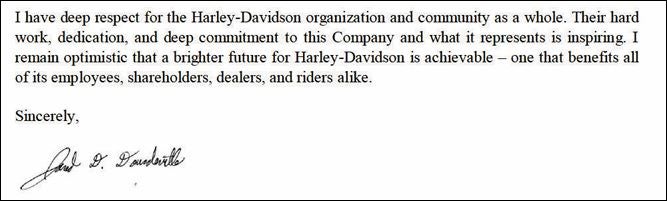
A portion of the letter sent by H Partners and former Harley-Davidson Board member Jared Dourdeville to Harley-Davidson. Image: H. Partners
Harley Responds
Shortly thereafter, Harley-Davidson responded, saying that Dourdeville knew what was going on and didn’t voice any concerns about the company’s Board. In summary, Harley claimed that up until December 2024, Dourdeville and H Partners had been requesting that Zeitz and Linebarger extend their commitment to stay with the MoCo for several additional years. They also said that in February 2025, Dourdeville voted in favor of all current company Directors standing for reelection. Harley also claimed they had been searching for a successor for Zeitz, including one that H Partners had recommended, but were unable to come to a consensus as to who to hire.
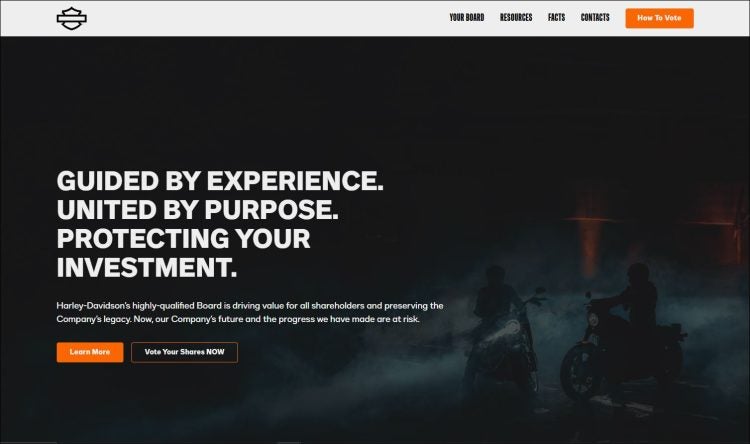
Image: Harley-Davidson
Taking Positions
Since Harley’s initial response, the companies have traded jabs at each other, with often conflicting points of view and “facts.” More importantly, H Partners has launched a proxy war against MoCo’s existing Board of Directors. Since Dourdeville’s resignation, the companies have submitted no less than 26 filings to the Securities and Exchange Commission (SEC) with information concerning their positions and the ongoing proxy battle.
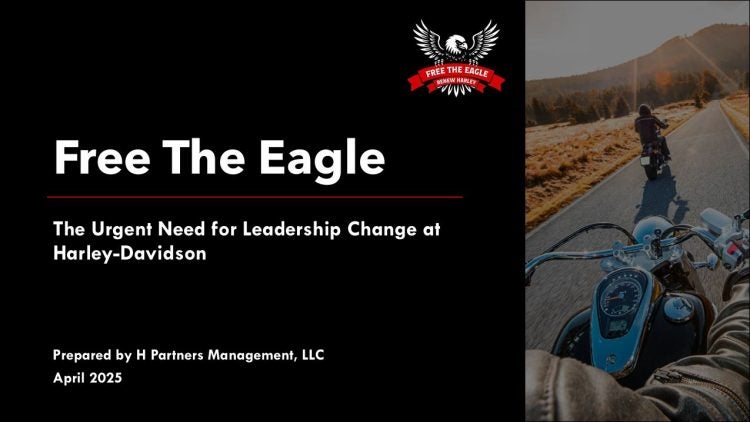
Image: H Partners
In addition, both companies have begun campaigns to bolster their position with shareholders. H. Partners has created its “Free The Eagle” program, submitting its position on the MoCo’s Board, while Harley-Davidson has launched its own program called “Vote Harley-Davidson.” H. Partners’ position is that over the last year, “…(1) there have been major execution issues at Harley-Davidson, overseen by an absentee CEO; (2) the CEO and Presiding Director have not been fully transparent with the rest of the Board; and (3) certain long-tenured Board members have been unwilling to hold the CEO accountable for severe value destruction and the cultural depletion of this iconic American company.”
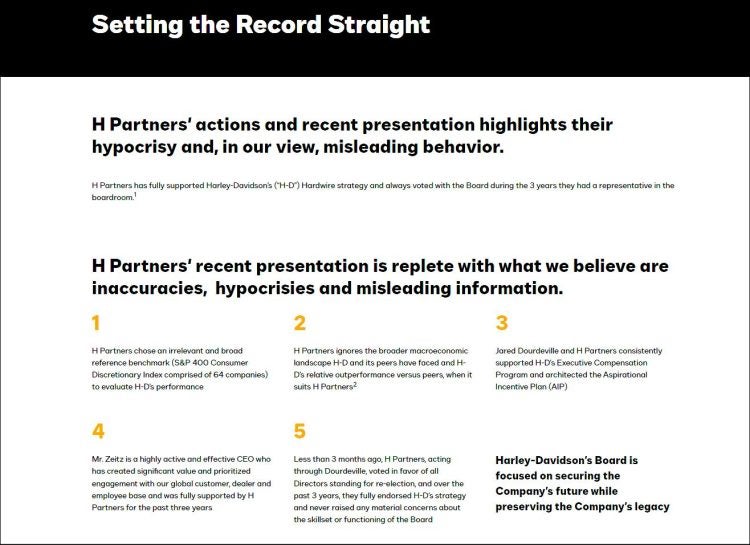
Image: Harley-Davidson
Harley-Davidson countered that H Partner’s campaign is a “…harmful and disingenuous campaign that puts the value of your (i.e., shareholders’) investment at risk.” Harley adds that H Partner’s program jeopardizes the strategic progress made to date, undermines the Board’s ability to attract the best CEO and future Director Candidates, seeks to remove one-third of the Board, and offers no constructive solutions.
The Back And Forth
The barrages against each other have been plentiful, so much so that it is getting somewhat difficult to track and determine whose position is the best for shareholders. In this regard, H Partners released an 82-page presentation on what they claim the facts are and suggesting that Harley hasn’t been truthful in its statements. Harley has since shot back at H Partners, “Setting the record straight,” disputing many of H Partners’ representations of events and benchmarks, while touting the experience of the current board.
Proxy War
In the end, H Partners seeks to make changes to Harley’s Board, while Harley appears comfortable with those in place now and the addition of a new Director to replace Dourdeville. We’ll know more about what changes, if any, will happen after Harley’s annual shareholders meeting is held on May 14th. As we’ve said before, stay tuned.