

LiveWire (now a separate brand from Harley-Davidson) wants people to know that yes, Virginia, you can customize a LiveWire electric motorcycle. To that end, it recently exhibited a couple of customized LiveWire Ones at a motor show, but not a traditional motor show: It was the Autopia 2099 EV-only show (once again: EV and tech shows appear to the future of electric motorcycle releases, not traditional motorcycle shows like EICMA and Intermot).
The bikes at the show were SMCO’s LiveWire One Hooligan Racer (two of these bikes were displayed), and Earle Motors’ E/MULHOLLAND CUSTOM. Here’s a look at each.

The SMCO bike was made for actual racing, in the Roland Sands Super Hooligan series. Photo: Harley-Davidson
SMCO: LiveWire One Hooligan Racer
Brothers Aaron and Shaun Guardado are the guys behind SMCO. They’ve had a long interest in racing, as they raced shifter karts and import cars through their teens, and then turned to motorcycles. They kickstarted SMCO in 2010 as a T-shirt brand, building custom competition bikes as promotion and also because they’re big fans of speed. A decade later, they’ve built Harley-Davidson flat trackers and hooligan racers, and also built a pair of H-D’s Street Rods into snow bikes for a mid-winter X Games hillclimb event.
In July of 2022, the Guardado brothers entered a pair of stock LiveWire One motorycles into a Super Hooligan race at Laguna Seca. They found the bikes fast and fun to ride, but realized there was plenty of room to improve on their performance. So, they started working on a race version. They put BST carbon-fiber wheels on the electric motorcycle, to reduce rotating mass. They stripped off the stock bodywork and used to to make molds for their replacement carbon-fiber bodywork, which reduced weight. They also put a set of rearset footpegs on the bike, to change riding stance.
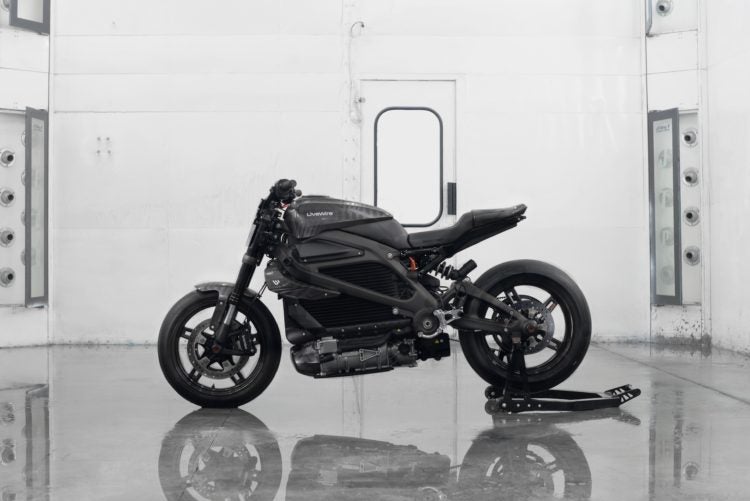
This bike’s custom parts could be re-created and sold for customers to tweak their own machines. Photo: Harley-Davidson
They showed this race-prepped machine at Autopia 99, and pointed out that since there’s no change to the chassis itself (everything attaches to the LiveWire’s stock mounting points), they could reproduce the race kit and sell it to other riders for DIY installation. If you want to race your LiveWire, or just do track days, this could be a good starting point.
Earle Motors: E/MULHOLLAND CUSTOM
This is more of a traditional-style custom, not a racebike like the Guardado brothers’ machine. Designer Alex Earle built this machine; he’s a powersports design teacher at the ArtCenter College of Design in Pasadena, California. He lives at the base of legendary Mulholland Drive, and says he loves taking his LiveWire One up the curvy road on a weekday evening, when it’s empty of the frantic weekend traffic. He says taking the quiet, smooth, cool-running all-electric Harley-Davidson is a great escape, especially when compared to a noisy and hot combustion-engined bike.
His Earle Motors customization shop (check it out, he’s got some other very cool ADV stuff there) is more of a creative outlet than a business, he says. That creativity was put to the test when he decided to customize his LiveWire One. Because it’s an electric bike, there’s no exhaust or fuel tank, and that’s where many traditional bike builds begin.
Without those easy starting points, Earle says he decided instead “to consolidate the design and adjust the ergonomics for my own comfort. I want it to fit like a tailored suit.”

The Earle Motors E/MULHOLLAND CUSTOM is designed to celebrate the glorious, twisty fun of Mulholland Drive. Photo: Harley-Davidson
To make the bike fit him like he wanted, he replaced most of the bodywork with pieces he designed himself, crated on a 3D printer. He had to leave the LiveWire’s faux fuel tank unmodified, since it’s filled with electronic bits that he didn’t want to tinker with.
Instead, Earle says,”I painted the electronics cover, which looks like a fuel tank, in Synthetic Haze, a gray-to-blue fade developed during World War II to help airplanes appear less visible in the sky, which lowers the profile of the entire bike.” Clever indeed, reusing 1940s technology to change the look of a very modern bike.
Other changes to the bodywork required some re-engineering to allow the cooling system to properly function, with Earle scanning the entire motorcycle and also drawing out what he wanted. From there, he went to the gurus at PROTOTYP3 (managed by two of his former students) and had them build a CAD model, and 3D printing from there to create the component he needed. Currently, it’s installed on the bike as a non-functional plastic component, but he thinks it could be re-created in aluminum and serve as a functional piece of the mechanical system.
-
- The Earle Motors custom is perhaps more of a traditional custom, not built for the track. Photo: Harley-Davidson

-
- Custom-printed parts show the way forward for custom bikes. We’ve come a long way from welded sissy bars. Photo: Harley-Davidson

That’s a long way from the old-school talents that guys like Jesse James showed on TV in the early 2000s, but it’s the approach that customization is going to take in the 21st century. However, Earle did put some of those traditional custom-finish and metal fabrication skills to work, building a new tailsection with custom motard-style seat to accommodate his six-foot, three-inch height. He had Saddlemen do the leather work on his seat. He also added an elk antler design to his new charging port cover, the same design that’s used by a well-known Mullholland Drive eatery.
In the press release on the project, Earle has some thoughtful perspective on his project, and the future of motorcycle customization in general.
“People have been hot rodding motorcycles the same way for 70 years, but how will that happen in the future, when bikes are electric? How will this generation customize a bike? They can 3D print their own parts. They could liquid cool the electronics. I’m hoping this project gets on Instagram and some 17-year-old in Portugal sees it and gets a spark of inspiration. That will be the future of customization.”
Will Earle and the Guardado brothers be pioneers of battery bike customization, then, the same way that Ed Roth, Arlen Ness and other California chopper builders pioneered so many of the trends of the past 50 years? Time will tell; They are certainly keen to get its LiveWire machines seen as more than just tech novelties, but as motorcycles worthy of personalization, just as much as a vintage Panhead.
For ADVrider founder Baldy’s views on the LiveWire, see here.