
What if I told you that you could ride 90 mph on the Autobahn comfortably and get up technical enduro tracks?
A couple of years ago, three friends and I set off on a journey from the Netherlands to the end of Kazakhstan, with the goal of re-creating a portion of the Silk Road. We ultimately got turned around by Azerbaijan (a story of geo-politics for another time) and ended up riding a loop through the best terrain that Türkiye and the Balkans had to offer, with Romania as the crown jewel.
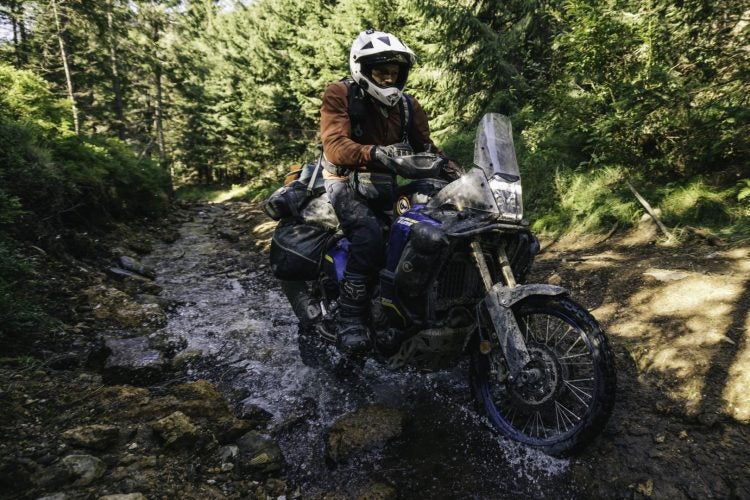
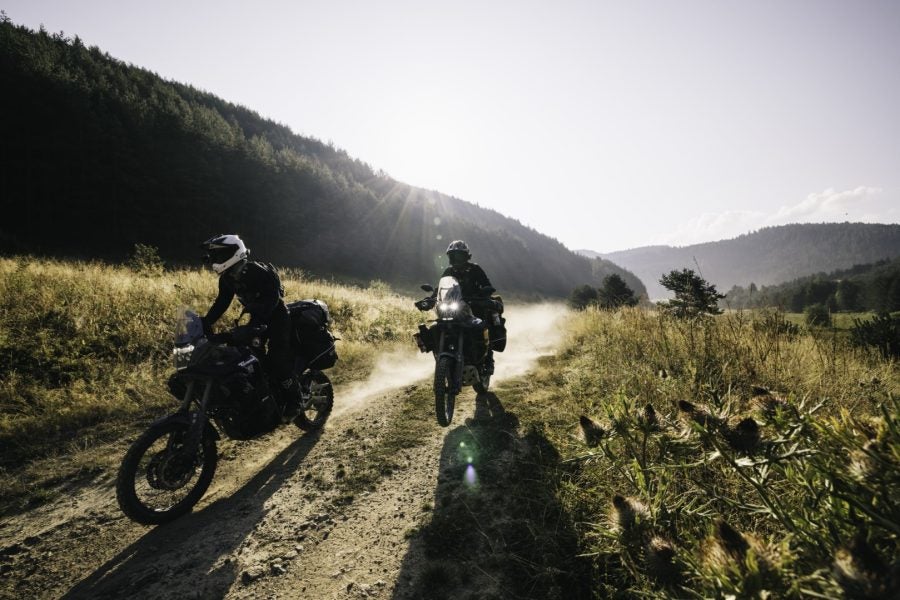
Sean and his riding mates used these bikes for a long-distance trip that put the bikes to test in every environment. Photo: Andy Cochrane
Leading up to this trip, the biggest unknown was what motorcycle to use. We had done rides like this before– including a month riding across Africa– but nothing that would ask this much of one motorcycle. Our baseline requirements were admittedly a bit unrealistic: we wanted a bike that could comfortably hold 90 MPH on the Autobahn and get us and a month’s worth of four-season gear up technical enduro tracks that were better suited for two-strokes.
To our delight, the Yamaha Tenere 700 World Raid ticked these boxes, and so many more. Yamaha’s official specs (below) laid out a pretty picture of everything we wanted, all in one place:
- 23-liter (6.07 gallon) capacity dual side-mounted fuel tanks
- Flat rally inspired two-piece seat
- 5-inch color display with smartphone connectivity
- 3-mode switchable ABS
- High specification 43mm KYB front fork 230mm travel
- Öhlins adjustable steering damper
- Aluminum piggyback rear shock long 220mm travel
- High-torque CP2 engine – two cylinder, four stroke, 690 cc
- 72.4 hp @ 9,000 RPM
- 50.2 ft -lbs torque @ 6,500 RPM
- 455 lb (wet)
- Off road designed air cleaner box
- 21’’ front wheel / 18’’ rear wheel
Early Apprehensions Put To Rest
When we picked up the bikes in Amsterdam, we were all a little surprised. The massive 23-liter tanks made the World Raid feel way bigger than the standard Yamaha Tenere 700 we had tested back in the States. Additionally, we had a lot of questions about hopping on a new bike you’re about to ride twelve hours a day for a month straight: how will it feel with all the luggage? How will it handle a steep, rocky, and rutted hill climb? Will it vibrate too much at highway speeds? And so on.
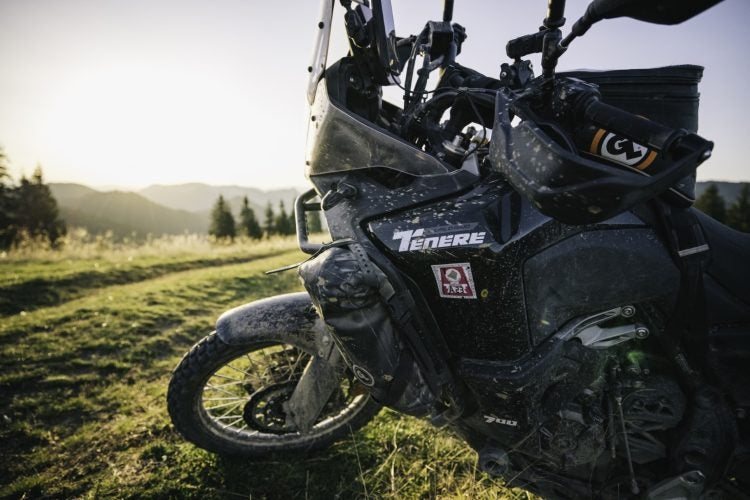
In its World Raid spec, the T7s required no massive pre-trip prep to get them ready for the overland journey. Photo: Andy Cochrane
Fast forward just three days and we had already ridden through the Netherlands, Germany, Austria, Italy, and crossed into Slovenia via a remote World War 1-era mountain pass. At that point we knew that the World Raids were comfortable and smooth at highway speed and could carve tarmac at a surprisingly high level. We were having the time of our lives pushing them to their limit – to the shock of the countless GSs, MultiStradas, and Africa Twins that we passed on our knobby Michelin Anakee Wild tires.
Dirt Joy and Revelations
Soon after entering Slovenia we hit our first dirt roads of the trip. The experience was one that I’ve had trouble describing without sounding hyperbolic. It was as if I suddenly found myself on an entirely different motorcycle than the one that felt so at home on tarmac.
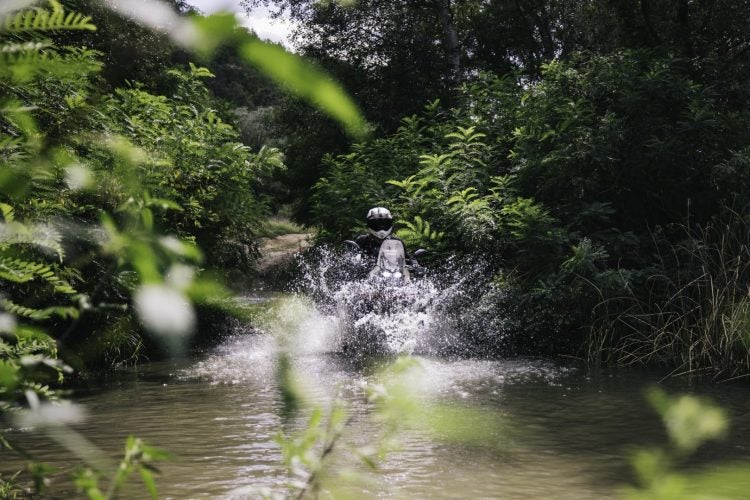
Although the T7 World Raid was based off the CP2 platform, originally made for the street, Sean’s group found them excellent for their off-road sections. Photo: Andy Cochrane
The power delivery was fantastically smooth, allowing us to predictably break the rear wheel loose on turns. The KYB fork and Ohlins steering damper created a joyous off-road experience, making the small bumps nearly disappear, absorbing big hits with ease, and energetically responding to throttle engagement and braking to make the most out of every type of terrain.
From this moment on, we didn’t think twice about road selection. We sought out the best dirt we could find and hopped back to tarmac when we needed to make up mileage. We spent the next month defying what we thought was possible as we traversed rock gardens, crossed rivers, climbed hills we could barely walk up, and generally had the time of our lives.
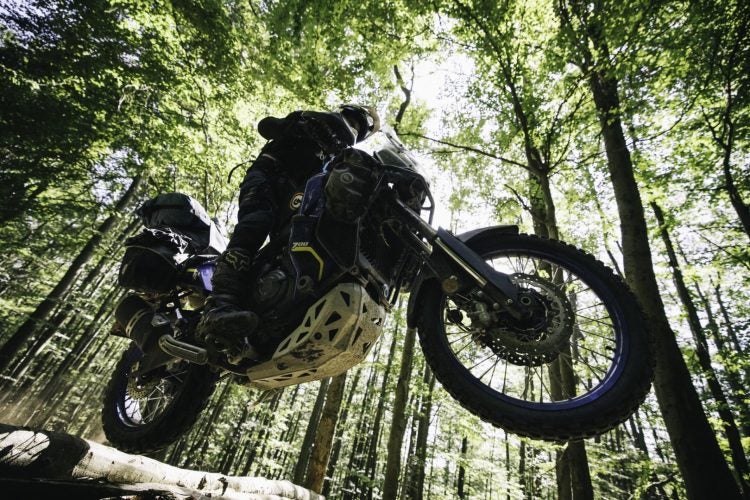
KYB fork and an Ohlins steering damper helped keep the bikes upright and headed straight. Photo: Andy Cochrane
After 6,500 miles any apprehension we had was a distant memory – these bikes were the perfect tool for this job.
Pros: Cross-Continent Reliability
If you can’t tell already, I love this motorcycle. Here are some features that stood out to me after a month of riding it everyday:
- Range: For a cross-continental trip like ours, the standout feature was the size of the tanks. This allowed us to make fewer stops and not stress when we ventured off into remote sections on the map.
- Off-Road Handling: The combination of the Ohlins steering damper, the 43mm KYB fork and the rear shock allowed us to ride off-road confidently despite having bikes loaded with 50+lb of gear. While navigating technical rocky or muddy terrain requiring slower speeds, the dampener helped mitigate the impact of quick bar movement as a result of front tire deflections.
- Reliability: We picked the bikes up with 0 km on the odometer, rode them like we stole them, and dropped them more than a dozen times (thank you crash bars!) All we had to do over the entire trip was check the oil, lube the chains, replace rear tires, and clean the air filters.
- Comfort: We routinely spent twelve hours a day on these motorcycles. The geometry was well suited for long highway days as well as days on dirt where we rarely sat down. This was true for all of us and we ranged from 5’10’’ to 6’2’’.
- Footpegs: I hate footpegs that are not wide or don’t have big enough metal teeth. Once the vibration dampening rubber inserts were removed– which we did immediately– the footpegs provided a wide and stable platform, 10/10.
Cons: Selectable ABS Modes Are Only Nice If You Can Select Them
On the right side of the handlebar, below the start/stop switch, is a small thumb-operated wheel. In theory you roll the wheel with your thumb to navigate through a menu on the display. Then you push the wheel in to make a selection. But, in reality it didn’t work at all.
The fatal flaw of this interface is that dirt and dust can easily clog it. After just two days of off-road riding, it stopped working on all four of our motorcycles. We later learned that this is a known issue. The suppression mechanism gets clogged with dust, rendering it inoperable.
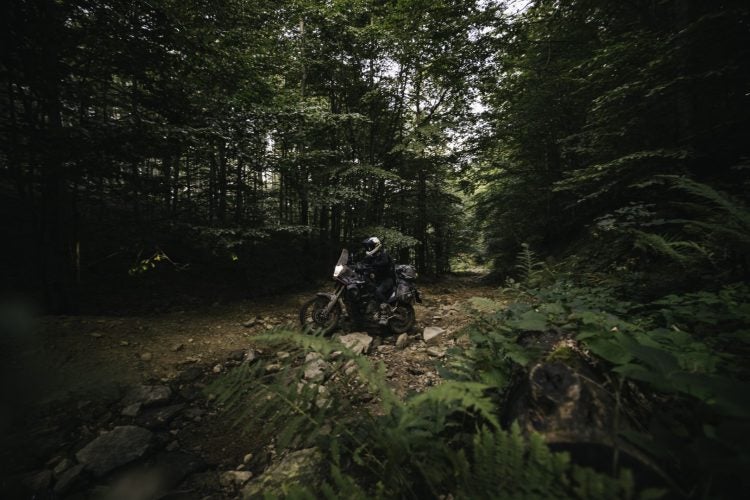
Aside from some issues with the switchgear, the ABS system’s lack of an offroad mode was an issue for the crew. Photo: Andy Cochrane
The most damning result of this failure was the inability to turn ABS off. We’ve all ridden long enough to be able to adapt to something like this, but if you’ve ever had rear-ABS on while navigating technical downhill descents, you know how unfortunate this can be. Let’s just say we all became experts in engine braking by the end of the trip.
Lastly, the World Raid version of the Yamaha Tenere 700 isn’t available in the States (yet?!).
Verdict: The Motorcycle That Can Actually Do It All
For many years I commuted, explored, and camped all over Uganda on a 1994 Honda XLR250 BAJA. I rode from Kilmanjaro to Cape Town on a first generation Royal Enfield Himalayan (it’s a tractor, but made the trip without a hitch). I’ve spent countless days across California and Baja on my trusty (and old) DRZ400S. My current bike is a KTM 500 EXC-F (the perfect bike if you don’t have to go on the autobahn).
My perspective on what you actually need to have fun or even ride across a continent is grounded in these experiences. That is, I generally don’t think you need what motorcycle companies are selling. One of the reasons why I love the Yamaha Tenere 700 World Raid so much is that it feels like you’re still riding a proper motorcycle, not a piece of tech that tries to do everything for you. I prefer to use a clutch and shift gears myself, thank you very much. I don’t want 10 different riding modes or the myriad of settings that many modern “adventure” bikes have.
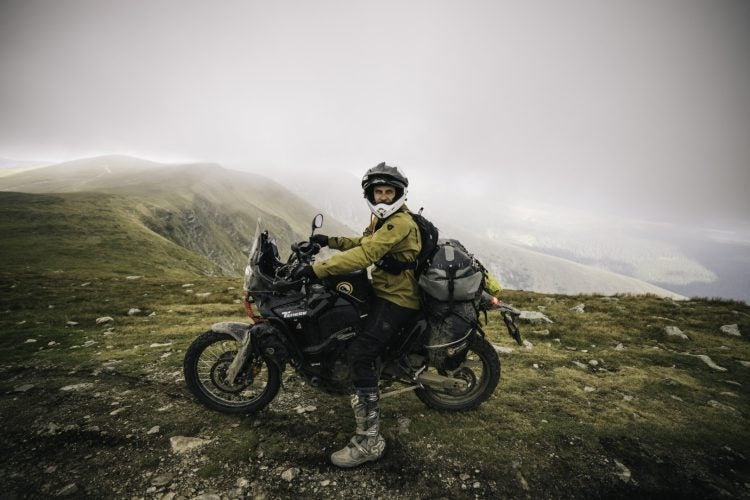
Sean’s takeaway: For him, this is the one bike that can do it all. Photo: Andy Cochrane
Most of us can’t afford more than one motorcycle– I know I can’t. If you only want to carve canyons on the weekend, you’ll probably love a Yamaha MT-09. If you are exclusively riding technical terrain and single track off-road, maybe a KTM 300 XC-W is right for you? If you are traveling across your country or your continent only on tarmac and tame gravel roads, then the new BMW GS 1300 is pretty compelling.
But, if you want the option to do anything mentioned above at a level of performance that will shock you, then I think the Yamaha Tenere 700 World Raid is the best option on the market.