
Leatt is a familiar name in the off-road riding gear world. They’ve recently started bringing their experience into the ADV world with boots and multiple jacket and pant offerings. To top it all off (literally), late last year, Leatt announced a pair of adventure helmet kits centered around the 8.5 and the 9.5 Carbon helmets. I received one of the first of these kits and have been trying it out as much as winter in the Ozarks has allowed me. I finally have enough hours and miles in this helmet to give it a thorough review.
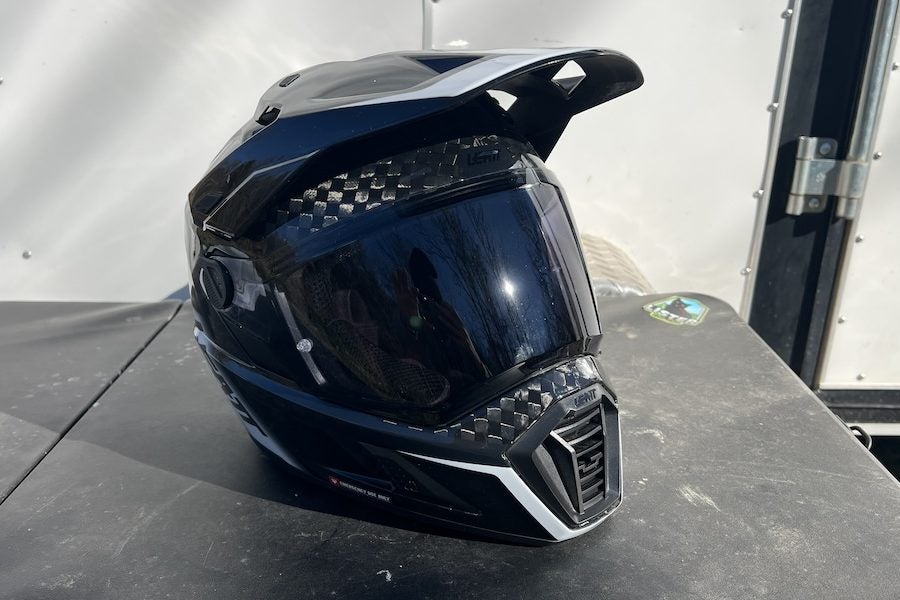
While I’ll focus on the 9.5 Carbon helmet that I have, much of this also applies to the 8.5, which is the same basic design with a composite shell instead of carbon fiber. Each is available in six sizes and three shell sizes. The medium/large 9.5 Carbon weighs 1,490 grams (about 3.28 lbs), while the same size 8.5 weighs 1,575 grams (3.47 lbs). I’ll mention the other differences in these helmets along the way, but there aren’t many.
The Helmet Kit
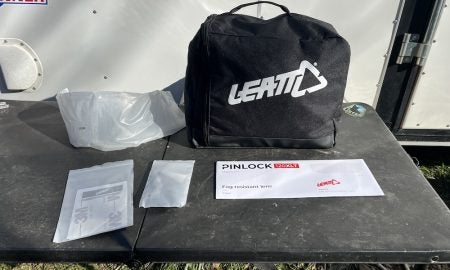
Photo: Justin Hughes
It’s important to note that Leatt doesn’t sell the 8.5 or 9.5 Carbon helmets as standalone items. The only way to buy them is as a complete kit. These include both photochromic (which automatically darkens in sunlight) and clear face shields, one Pinlock 120XLT MaxVision anti-fog shield, a helmet bag, spare parts, and a pair of Velocity 4.5 goggles, all of which come standard with the 8.5. The 9.5 Carbon kit upgrades the bag to one I’d be happy carrying on an airplane with me, and the goggles are upgraded to the Velocity 4.5 Iriz. While $799 is a hefty price tag ($599 for the 8.5 kit), you do get quite a lot for that money.
Features and Safety
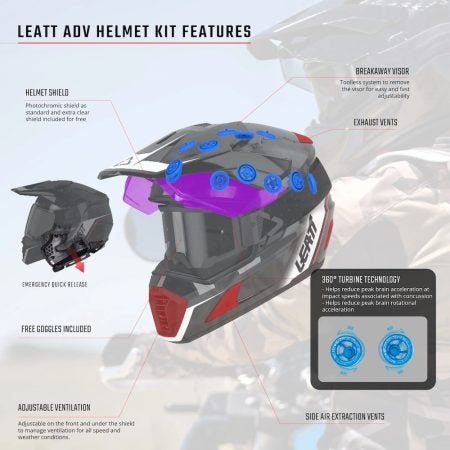
Image: Leatt
Leatt has always prioritized safety, starting with its first product, a neck brace. That focus continues in today’s gear. In addition to a tough shell (a six-layer carbon matrix in the 9.5 Carbon or a three-layer composite matrix in the 8.5) and standard EPS foam, Leatt uses its unique 360º turbine technology throughout the helmet. These small round blue pieces may look like they’re there for ventilation or even just decoration. However, they are specially designed to reduce peak brain acceleration in the event of an impact. In other words, they help your head slow down more gently as it impacts the inside of the helmet, which, in turn, reduces the force transferred to your brain, reducing the chance of concussion, among other injuries. Additionally, the cheek pads in both helmets feature an emergency quick release, enabling rescuers to easily remove the helmet once they have determined that doing so is safe.
Both helmets have excellent ventilation. A large front vent brings air straight in the front through a filter to help keep the dirt out. Two small vents on top of the helmet, under the visor, bring in more air to cool the top of your head. All of these vents can be closed, though the top ones are a little awkward to operate with the removable visor on. Six exhaust vents, always open, keep the air flowing freely. Since I tested the helmet during a southern winter, I did not have the opportunity to see how it performs on particularly hot days, but I was perfectly comfortable even at low speeds in temperatures up to the 70s.
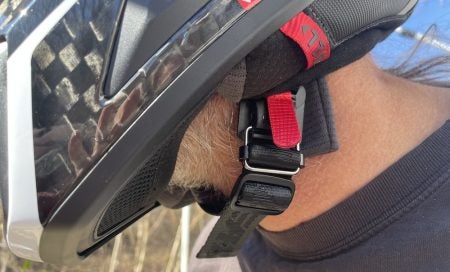
Photo: Melissa Leger
The 8.5 has a standard D-ring for the chin strap, while the 9.5 Carbon includes a magnetic Fidlock buckle. At first, I was skeptical that a mere magnet would be strong enough to keep my lid on, especially under the extreme forces of a crash. However, the design has grown on me. The magnet just holds the parts together, while the force to pull the helmet off is at a right angle to that connection and quite secure. It’s very easy to remove when you want to, though contrary to Leatt’s claims, I still struggle to find the pull tab with gloves on. That’s probably my issue, not theirs.
Leatt’s helmets do not have provisions for a specific brand or model of helmet communicator, instead supporting any Sena, Cardo, or other brand you wish to install. I had no trouble installing my Cardo on the 9.5 Carbon, with my speakers replacing pads in the EPS foam cutouts designed for this purpose. There’s even a small notch in the rubber trim along the bottom of the helmet specifically to guide your wires inside. It fits perfectly, works perfectly, and I have no problem hearing it, even at highway speeds.
On the Road
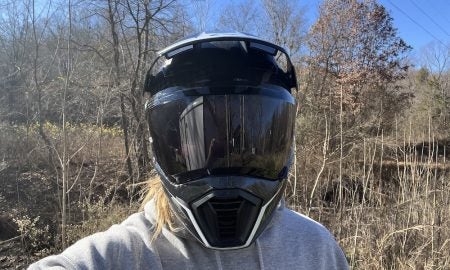
Photo: Justin Hughes
The photochromic face shield comes already installed on the helmet. I used it for most of my testing and installed the Pinlock anti-fog shield on it. It transitions from almost clear to fairly dark rather quickly. It worked wonderfully in sunlight but was darker than I prefer when it darkened itself on cloudy days. This is when I would switch to the clear face shield. I find that I prefer an integrated sun visor that I can flip up and down manually, but I understand that Leatt tried hard to keep the weight down in these helmets and that such a mechanism is much heavier than a photochromic face shield. The viewport is quite large, to the point where I could barely see the helmet itself in my peripheral vision. This also helps accommodate the goggles, which I’ll get to later.
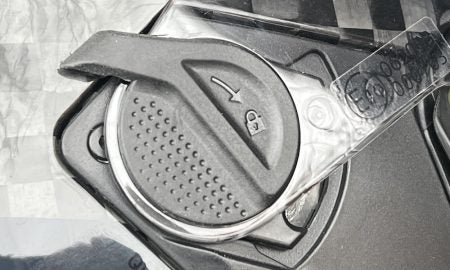
Photo: Justin Hughes
The face shield is easy to change without tools or even a coin, as I’ve used on some helmets. Simply twist a plastic piece on each side and everything pops off easily. Installation is the opposite of removal. An extra pair of these connectors is included in the kit. This is a good thing, as one of mine broke one of the first times I swapped shields. I was home when it happened with the helmet bag right there, so I popped the spare on and have had no trouble ever since. It’s possible that colder temperatures may have had something to do with why the plastic broke.
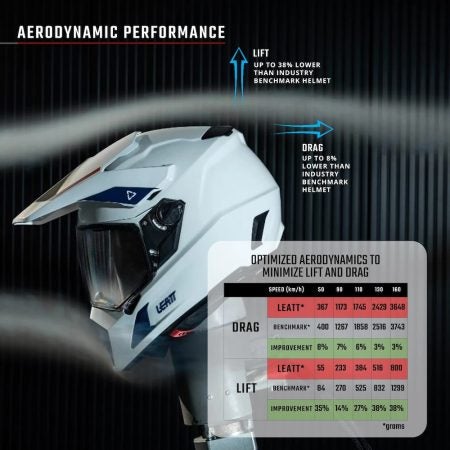
Photo: Leatt
Angular ADV helmets are not nearly as aerodynamic as smooth, round street helmets. I’ve definitely noticed my head getting blown around a lot more by the wind in every ADV helmet I’ve ever used. Leatt has gone to great lengths to make the 8.5 and 9.5 Carbon as slippery as possible through the air, claiming 38% less lift and 8% less drag than the industry benchmark. I can’t validate these exact numbers, but I can say that the Leatt 9.5 Carbon is the least susceptible ADV helmet to wind buffeting I’ve ever used. The only exception to this is strong crosswinds, which still blow my head around a bit. This is hard to avoid in any helmet with as large a side profile as an ADV helmet. I run a large Givi windshield on my V-Strom during the winter, but even on my wife’s KLR with minimal wind protection, I don’t fight the wind at all, even at highway speeds. Between this and the low weight, I’ve ridden for several hours a day with no head or neck fatigue.
On the Dirt
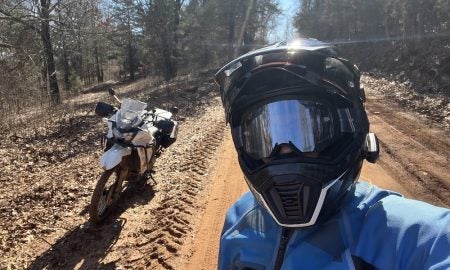
Photo: Justin Hughes
The dirt county roads I live on were still pretty muddy, but the first warm day of the year was the perfect opportunity to steal borrow my wife’s KLR with its knobby tires and go exploring in dirt mode. I put the Velocity 4.5 Iriz goggles to use, though I left the face shield attached instead of removing it entirely. The goggles fit perfectly on the helmet, which makes sense because they were literally made for each other.
I didn’t grow up on dirt bikes, so this was actually my first time using goggles on the bike. I have little to compare them to, but I can say there was no fogging whatsoever. Leatt says there is a permanent anti-fog function built into the inner lens. I also wasn’t breathing into the goggles. Again, I was unable to test them in hot weather because I tested them in winter. They did fit over my glasses pretty well, though I would’ve been more comfortable without the goggles’ pressure on my glasses frames. It wasn’t bad, but I did notice it.
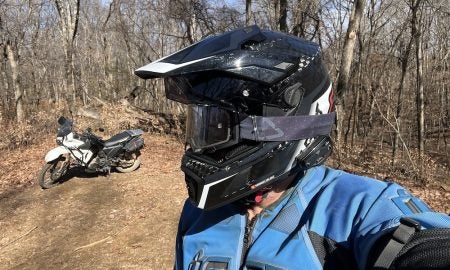
Photo: Justin Hughes
Once again, the excellent ventilation kept my head cool, even at slower speeds on the rough county roads. Breathing was easy, especially without the face shield in place and my nose exposed directly to the outside air. I didn’t notice the weight of the helmet at all as I bounced over bumps, something I can’t say about some heavier helmets I’ve used. I spent a couple of hours exploring and felt no weight or fatigue at all. I left the goggles on for a short pavement sprint from one county road to the next, and there was quite a bit of wind noise and buffeting at 55 mph. That’s only to be expected in this configuration. In the future, I’ll take off the goggles and flip down the face shield for a smoother, quieter ride when it comes to pavement.
You Get What You Pay For
I’ve put most of my ADV miles on a pair of Scorpion EXO-AT950 helmets. It is a perfectly good helmet, but certainly on the more affordable end of the spectrum, currently selling for $199 on Amazon. It weighs about 4 lbs, significantly more than even the Leatt 8.5, never mind the 9.5 Carbon. That weight difference adds up over a long ride. All of the touch points on the Leatt helmets are of higher quality, except perhaps the mechanism to open and close the front air vent. (According to Revzilla’s review, this is a known issue on preproduction models that Leatt is aware of and intends to improve in production. It may already be fixed by the time you read this). After installing my Cardo, the Scorpion’s pads have never fit quite right, while the Leatt’s fit just like new. Then, consider all the extra goodies that come in Leatt’s helmet kits. With all that in mind, these helmets are well worth their not-insignificant price tags.
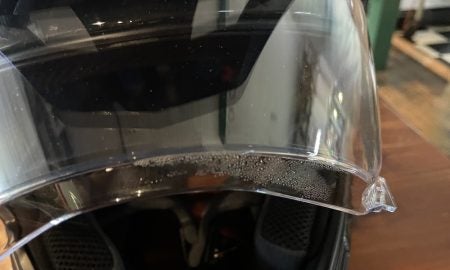
Photo: Justin Hughes
The only additional thing I wish was included in the helmet kit is a second Pinlock for the included second face shield to make swapping on the fly that much easier. Otherwise, you either have to swap the Pinlock back and forth or put up with fogging on the shield that doesn’t have it. It fogs up pretty badly without the Pinlock, but it is not a problem at all with it installed. You can see the difference in this picture, where the shield is rather foggy up until it meets the Pinlock, where it disappears completely.
I freely admit that I’m nitpicking here. A second Pinlock costs $39.99, and though I don’t see it listed on Leatt’s website, it’s available elsewhere online. Leatt’s helmets are still a great deal for what you get. If $799 for the 9.5 Carbon is too much, you certainly won’t be settling if you get the $599 8.5 instead.