

Everyone knows about Fox Racing. They make a lot of different stuff, but in the motorcycle world, they’re focused on the MX segment, right?
In 2025, Fox is branching out beyond berms and whoops, building a new line of ADV gear. I had one of their Defend suits to try on a recent jaunt through the southwestern US. Here’s how it worked for me.
Construction
The Defend jacket and pants are made of heavier-weight material, which is why I selected them for this cold-weather trip—although they have some very useful venting, which I got to try out towards the end.
Their shell construction is mostly nylon, with a bit of polyester thrown in, and some elastene for stretch. The road-rash-resistant exterior is bonded to Gore-Tex for a two-layer material with sealed seams to keep water out. This is about as good weatherproofing as you’ll get in a mass-market ADV suit.
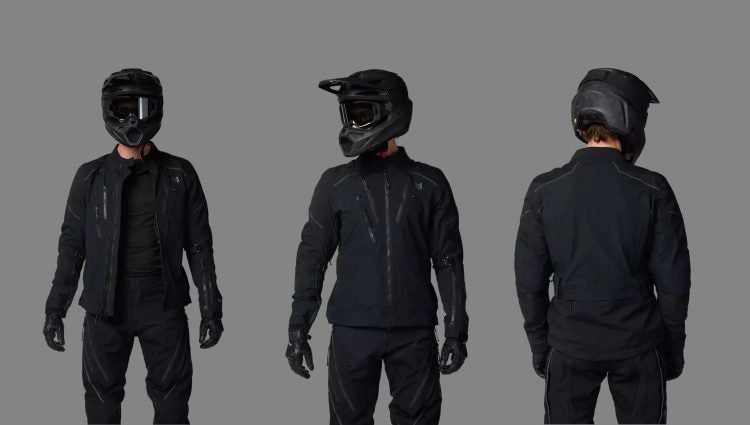
I opted for the orange gear, because… I like orange. But the Defend suit also comes in basic black, which is probably a better choice for a lot of riders. Photo: Fox
The cut of the jacket is streamlined. I don’t mean it’s a snug fit (it’s cut for American sizes. not the leaner cuts like you get on some Euro stuff). I mean I’m used to ADV jackets with lots of buckles and pockets and other stuff hanging off the front, and the Defend jacket doesn’t really have that. There are handwarmer pockets, but they’re integrated more into the side of the jacket. The waterproof vents on the front are sleek. The whole thing is much more sporty and enduro-ish looking than older touring-oriented jackets. It looks more like a weatherproof shell jacket that you’d throw over armor than an actual protective layer itself, almost futuristic.
Speaking of the built-in protection: There’s a CE-certified Level 1 D3O Viper back protector, and Level 2 D30 LP2 shoulder and elbow protection in adjustable pockets, so you can set the padding where it fits best. The pants come with removable Level 2 CE-certified D3O LP2 knee armor, also in adjustable pockets for a better fit.
For night-time visibility, you get the usual scattering of reflective trim. The fabric is reinforced in high-wear areas so they don’t wear out as quickly, and to offer better protection in a slide.
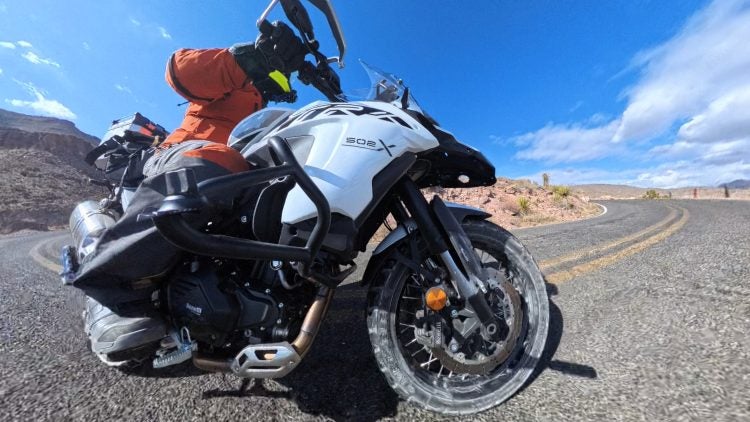
This picture actually *is* me, zipping around Historic Rt 66 to Oatman, Arizona. It’s the sort of road where you’ll want to move around on the bike, and the Fox Defend gear worked nicely, with lots of stretch in the material. Photo: Zac Kurylyk
The jacket has adjustability tabs on the sides and on the sleeves, but they’re very discreet, not the flappy monstrosities you see on some designs. On the pants, an adjustable tab at the waist as well as tabs at the bottom of the legs help you get a fit that suits you.
Fox knows that you need to have plenty of venting if you have a suit that relies on heavy fabric bonded with Gore-Tex, and that’s what we see here, with underarm vents, on the jacket, large vents at the front with hooks to hold them open channeling air through, and a vent built into the full-length front zipper closure. If the temperature rises, you can convert that front zipper into a massive intake vent for immediate cooling.
The pants have similar large vents on front and back. This kit is made to flow as much air as is reasonably possible. See Fox’s demo of this gear below for a better idea of how it all fits together.
Two thousand miles of testing
I wore this gear on a recent run through Arizona, Utah and Nevada over the end of January and start of February, for nearly 2,500 miles of everything from desert dirt roads to high-speed highways and everything in between. That meant a wide range of temperature changes, from well below freezing to the low 70s Fahrenheit (low 20s Celsius). It’s hard to find gear to accommodate such a wide range of temperatures well, and the Defend jacket and pants have no thermal liner to keep you warm in colder temperatures. I’m totally fine with that, because I almost never wear the liners included with gear anyway. On this trip, I wore an electric heated vest and layered a few shirts against the cold under the jacket, and wore a set of merino longjohns under the pants. It worked fine, and for most of the trip, when temperatures were closer to the 50 Fahrenheit/10 Celsius mark, I was plenty warm. When the temperatures were colder, a warmer set of base layer bottoms would probably have made more difference than more layers on my torso.
When the weather finally heated up at the end of my tour, I was happy to find the Fox Defend gear flowed air very well. While nothing will beat the comfort of mesh under a blazing sun or in sticky humidity, this suit was still comfortable when things got warmer, and I would have no hesitation to wear it on a cross-country tour unless it was the heat-warning time of year.
Initially, the Defend gear was just a tad bit stiff, but much better than textile jackets used to be. In the past, it could take weeks for riding gear to break in—does anyone remember putting their new Aerostich into the dryer with some tennis balls, to speed up the break-in period? Thanks to the stretch material in the Fox Defend’s fabric, that process is a lot quicker now, and moving around the bike and climbing into the saddle was comfortable after only a few days. Heavier fabric like this will never move quite as freely as lighter gear, but I felt this was very comfortable very quickly. Armor placement felt good, there was no chafing or other annoyance from the collar, no stitches of Velcro poking into me anywhere.
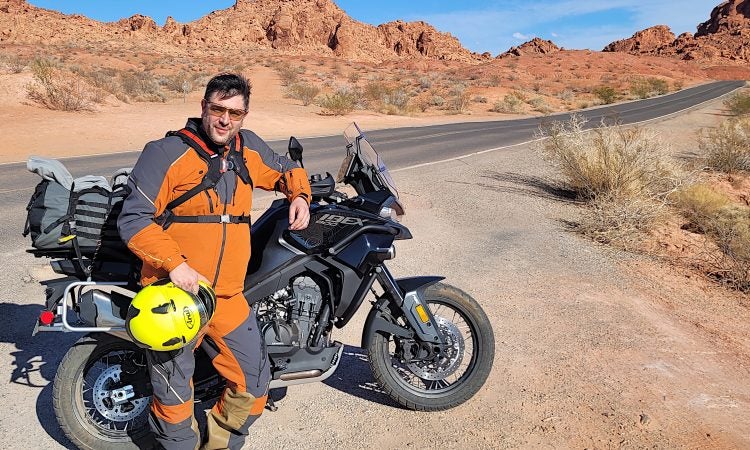
Hot desert days. Or at least, it felt hot; compared to the near-freezing temps of the week before, the toasty sun in Valley of Fire left me opening the zips to cool off. The Fox Defend gear seemed to flow air pretty well.
I did a lot of long-mile days on this trip, and that gave me a lot of time to think about the jacket’s design. At first I was not a fan of the streamlined layout, with pockets on the side instead of the front; when I’m on the road, I like to have my pockets quickly accessible for equipment I need (notebooks, pens, camera), and I have long found slit-style pockets on the side of pants or jackets are a sure-fire way to lose stuff. As well, stuffing gear into the internal front pockets did nothing to slim down my Dad bod look.
However, after using the jacket for a while, I came to appreciate the well-designed pockets on the inside of the front, on both the left and right of the zipper. On the inside, it’s easier to keep their contents dry, and less openings and stitching on the front of the jacket means better waterproofing on the exterior as well. Not that I had the chance to test this—it didn’t rain during my 11-day trip.
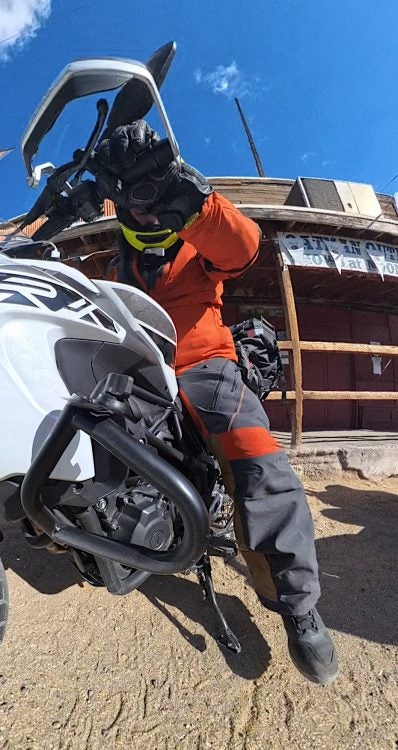
The leather on the pants’ lower legs keeps you from scorching them on your exhaust. The Velcro adjustment tabs on the back allow you to cinch them down very tight, which is nice if you’re trying to keep from catching on trailside brush.
It might seem silly to make this much ado about pockets, but pockets and zippers are the parts of your jacket that you’ll actually use the most on the road. And speaking of the zipper, I will say that despite Fox using a high-quality YKK AquaGuard zipper on the front, I did find it a bit finicky to use. All the other flaps and openings and vents on pants and jacket were flawless, but sometimes when I went to connect the two sides of the front zipper, it felt like there was an alignment issue when getting them to actually connect, and it took some fidgeting. Once zipped together, there were no issues. I don’t think this should concern potential buyers, because Fox’s lifetime warranty guarantees they’ll make something right if it has a manufacturing or material defect. In this case, it was YKK’s product anyway, not a function of Fox’s build quality. On the contrary, for a first-time effort, I think the Defend’s build quality was pretty good—I’ve had textile gear from established OEMs that came with far rougher construction.
The bottom line
The price of quality ADV gear keeps rising; the Fox Defend jacket sells for $699.95 in the US, and the pants are $649.95. That’s in line with lower-priced Klim kit and higher-priced REV’IT! stuff; it’s right around where mid-range Alpinestars MSRPs sit.
-
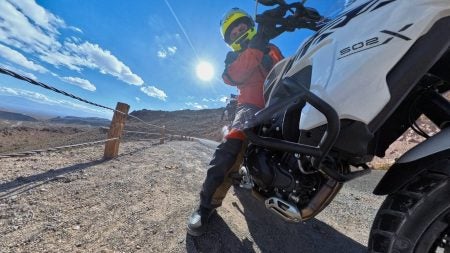
- I didn’t use the pants pockets very much, but they’re there if you need them, on the thighs. This is much better than having hip pockets; you’re less likely to lose your wallet, etc.
-
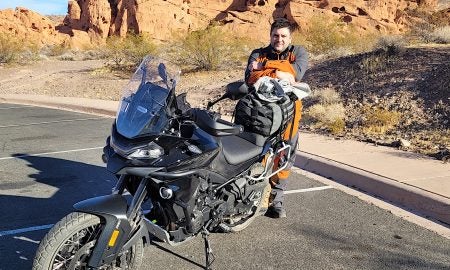
- After nearly 2,500 miles in this gear, I’d recommend anyone take a look at it, if they’re on the market for good-quality, mid-priced kit.
I think that’s about fair for the Fox gear, but it will take a few years on the market for the majority of ADVriders to decide whether that’s true for them. Fair enough, but Fox does have a long history of producing gear for motocross and downhill MTB, and that has held up well for countless riders. If their new stuff does the same. I think they’ll be a serious competitor in the ADV gear space—and from what I’ve seen so far, I think buyers will be happy with their gear.
Revzilla has the Fox Defend jacket here, and the pants are here.